

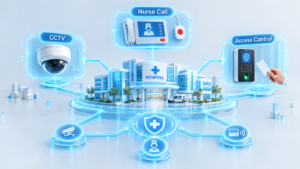
Learn how integrating nurse call, CCTV, and access control improves...
اقرأ المزيدعن الشركة

تساعد شركة فيوتشر إنترست للتجارة المؤسسات والشركات على تبني التحول الرقمي من خلال حلول مبتكرة في البنية التحتية لتكنولوجيا المعلومات، والحلول السحابية، والأمن السيبراني، والشبكات، والخدمات المدارة.
التصنيفات
الأرشيف
تواصل معنا

Healthcare Cybersecurity in Saudi Arabia: Protecting Critical Hospital and Patient Data
Saudi hospitals protect patient data and maintain uninterrupted care by building cybersecurity into every layer of their IT infrastructure — from network segmentation and identity management to continuous monitoring and NCA-aligned compliance.
Healthcare organizations across the Kingdom are moving fast on digital transformation. Electronic health records, connected medical devices, cloud platforms, telemedicine, and AI-powered clinical systems are now standard parts of hospital operations. These technologies improve patient care and efficiency, but they also open new doors for cyber risk.
For a hospital, cybersecurity isn’t just an IT line item. A single breach can compromise patient privacy, disrupt clinical systems, and in the worst cases, affect the availability of care itself.
Why Healthcare Cybersecurity Matters in Saudi Arabia
Hospitals sit on some of the most sensitive data that exists: medical records, national ID and contact details, diagnostic and lab reports, prescriptions, insurance and billing information, staff records, medical-device data, and day-to-day operational information. A single incident touching any of this can expose confidential patient information or take essential services offline.
Saudi Arabia has built a strong regulatory foundation around this risk. The National Cybersecurity Authority (NCA) sets the national framework through its Essential Cybersecurity Controls (ECC 2-2024), Data Cybersecurity Controls, Critical Systems Cybersecurity Controls, and Cloud Cybersecurity Controls. On the data side, the Personal Data Protection Law (PDPL) establishes clear obligations for how personal information is processed and protected.
Together, these frameworks push hospitals toward treating cybersecurity as a combination of data protection, infrastructure security, operational resilience, regulatory compliance, and continuous monitoring — not any one of these in isolation.
Common Cybersecurity Threats Facing Hospitals
Ransomware. A ransomware attack can lock hospitals out of the systems they rely on to function day to day. Strong access controls, tested backups, and a documented incident-response plan are the baseline defense.
Phishing and credential theft. Hospital staff are frequent phishing targets because their credentials open the door to clinical and administrative systems. Multi-factor authentication, staff awareness training, and email security controls all reduce this exposure.
Medical device security. Connected equipment and Internet of Medical Things (IoMT) devices expand a hospital’s attack surface. Outdated firmware, weak authentication, and poor network segmentation are the most common weak points.
Insider risk. Large clinical and administrative workforces mean many people touch sensitive data every day. Role-based access control keeps each employee’s access limited to what their role actually requires.
Third-party and cloud risk. Hospitals depend heavily on cloud platforms, software vendors, and managed IT providers. The NCA’s Cloud Cybersecurity Controls specifically address cloud service providers and tenants, including data localization requirements — making vendor security assessments a compliance issue as much as a technical one.
Key Cybersecurity Measures for Saudi Hospitals
- Strong identity and access management. Multi-factor authentication, role-based access control, privileged-access management, strong password policies, regular access reviews, and automated deactivation of unused accounts together keep unauthorized users out of clinical and administrative systems.
- Network segmentation. Separating critical systems from general corporate networks — patient systems, clinical applications, medical devices, administrative systems, and guest networks each in their own zone — limits how far a breach can spread if one segment is compromised.
- Patient data protection across its lifecycle. Data needs protection from the moment it’s collected through storage, transmission, use, archiving, and secure disposal. This is precisely what the NCA’s Data Cybersecurity Controls are built to enforce.
- Backup and disaster recovery. Backups only matter if they can be restored. A solid disaster recovery strategy identifies critical applications, recovery priorities, recovery time and point objectives, backup requirements, emergency communication procedures, and clear ownership during an incident — and tests all of it regularly.
Compliance and Cybersecurity in Saudi Healthcare
Saudi healthcare organizations need to map their operations against the frameworks that actually apply to them, rather than assuming one control set covers everything. The relevant NCA frameworks are the Essential Cybersecurity Controls (ECC), Data Cybersecurity Controls (DCC), Critical Systems Cybersecurity Controls (CSCC), and Cloud Cybersecurity Controls (CCC). The CSCC in particular covers governance, defense, resilience, and third-party/cloud cybersecurity as distinct domains. Each hospital should assess which requirements apply to its own systems, services, and regulatory footprint.
Building 24/7 Security Monitoring
Point-in-time security checks aren’t enough for a modern hospital environment. Continuous monitoring — covering network traffic, servers, endpoints, cloud environments, user activity, security events, critical applications, and medical-device networks — is what allows suspicious activity to be caught early instead of after the fact. A Security Operations Center (SOC), whether run in-house or through a managed service provider, is the mechanism most hospitals use to make this monitoring practical around the clock.
Cybersecurity Awareness: The Human Factor
Technology alone doesn’t secure a hospital. Staff need regular training on phishing awareness, password security, safe email practices, handling sensitive patient information, reporting suspicious activity, secure mobile device use, and social engineering risks. This human layer is a consistent theme in Saudi Arabia’s national cybersecurity strategy, which emphasizes maturity, protection of networks and data, and workforce awareness of cybersecurity responsibility.
How Healthcare IT Infrastructure Supports Cybersecurity
A secure hospital needs more than antivirus software and a firewall. It needs secure networking, endpoint security, identity management, cloud security, data protection, backup, monitoring, and disaster recovery working together as one architecture — not as separate, disconnected tools. Framed this way, cybersecurity becomes part of the hospital’s overall technology strategy rather than an isolated IT function bolted on afterward.
Cybersecurity Checklist for Saudi Hospitals
Area | Key Question |
أمن الشبكات | Is the hospital network properly segmented? |
Access Control | Do users have only the access they need? |
Patient Data | Is sensitive data appropriately protected? |
Medical Devices | Are connected devices monitored and secured? |
Cloud | Are cloud environments configured securely? |
Backup | Are critical systems regularly backed up and recovery tested? |
Monitoring | Are security events continuously monitored? |
Employees | Are staff regularly trained in cybersecurity? |
Incident Response | Is there a documented response plan? |
Compliance | Are applicable Saudi cybersecurity and data-protection requirements being addressed? |
الأسئلة الشرائعة والمتكررة
What cybersecurity regulations apply to hospitals in Saudi Arabia? Hospitals typically need to align with the NCA’s Essential Cybersecurity Controls, Data Cybersecurity Controls, Critical Systems Cybersecurity Controls, and Cloud Cybersecurity Controls, along with the Personal Data Protection Law (PDPL) for how patient data is processed and protected.
What is the biggest cybersecurity risk for hospitals? Ransomware and phishing are the most common entry points, but the risk that causes the most damage is usually a combination of factors — weak access controls, unsegmented networks, and untested backups — that turns a single incident into a full operational disruption.
Do connected medical devices need separate security measures? Yes. IoMT and connected medical equipment should sit in their own network segment, with monitoring and access controls suited to their specific update cycles and authentication limitations.
The Future of Healthcare Cybersecurity in Saudi Arabia
As digital transformation continues, Saudi hospitals will lean further into connected systems, cloud infrastructure, AI, and digital health platforms — which makes cybersecurity a permanent fixture of healthcare infrastructure, not a one-time project. The shift hospitals need to make is from reacting after an incident to operating proactively: continuous monitoring, secure infrastructure, data protection, employee awareness, and recovery plans that are actually tested. The NCA continues to update its frameworks and guidance, including recent work on cybersecurity risk management and workforce development, so this is a moving target that hospitals need to track on an ongoing basis.
خاتمة
Healthcare cybersecurity in Saudi Arabia protects patient data, keeps hospitals running, and supports trust in digital healthcare. Getting there takes secure IT infrastructure, identity and access management, network segmentation, data protection, cloud security, continuous monitoring, employee training, incident response, and disaster recovery working together. For Saudi hospitals, cybersecurity isn’t an IT expense — it’s a core part of patient safety, operational resilience, regulatory compliance, and digital healthcare transformation.
Ready to strengthen your hospital’s cybersecurity posture? FITCO helps Saudi healthcare organizations build NCA-compliant, resilient IT infrastructure — from network segmentation to 24/7 monitoring. Get in touch to schedule a security assessment.
أحدث المقالات

Hospital Disaster Recovery Solutions in Saudi Arabia | Business Continuity
Disaster recovery and business continuity solutions help hospitals in Saudi...
اقرأ المزيد
Managed IT Services for Government Entities in Saudi Arabia | Benefits, Risks & Costs
Explore how managed IT services help Saudi public entities improve...
اقرأ المزيد