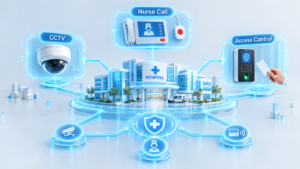
Modern hospitals run on data as much as they run on medicine — patient records, diagnostic imaging, billing, staff scheduling, and life-critical monitoring systems all depend on IT infrastructure that simply cannot fail. The right technology stack keeps care fast, compliant, and secure; the wrong one creates risk at every level, from a delayed lab result to a full-scale data breach.
Here’s what that infrastructure actually needs to include.
What Is Hospital IT Infrastructure?
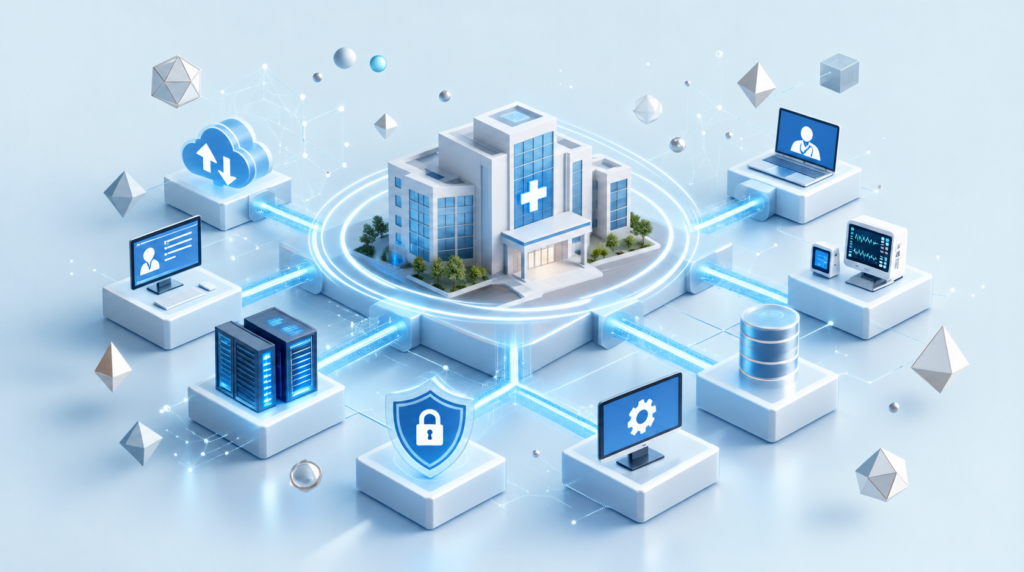
Hospital IT infrastructure is the combined network of hardware, software, connectivity, and security systems that allow a healthcare facility to store patient data, run clinical applications, and keep every department — from the ER to the pharmacy — communicating in real time. It spans everything from the servers hosting an Electronic Health Record (EHR) system to the Wi-Fi network supporting bedside monitors.
Why Does Hospital IT Infrastructure Matter So Much?
Downtime in a hospital isn’t an inconvenience — it’s a patient safety issue. A single network outage can delay medication administration, block access to imaging results, or disrupt emergency communications. Reliable infrastructure directly affects clinical outcomes, regulatory compliance, and operational cost, which is why hospitals typically invest far more heavily in IT resilience than most other industries.
What Are the Core Components of Hospital IT Infrastructure?
1. Electronic Health Records (EHR) Systems The backbone of clinical operations. EHR platforms centralize patient history, prescriptions, lab results, and treatment plans, making them accessible to authorized staff across departments instantly.
2. Network Infrastructure and Connectivity High-availability wired and wireless networks (with built-in redundancy) ensure that medical devices, workstations, and mobile carts stay connected without interruption, even during peak load or partial outages.
3. Data Storage and Backup Systems Hospitals generate enormous volumes of data daily — from imaging files to continuous monitoring logs. Secure, redundant storage with automated backups protects against data loss and supports fast disaster recovery.
4. Cybersecurity and Compliance Tools Firewalls, intrusion detection, endpoint protection, and encryption are non-negotiable given how frequently healthcare data is targeted. Compliance frameworks (like HIPAA in the US or equivalent regional standards) also shape how systems must be configured and audited.
5. Medical Device Integration (IoMT) Connected devices — infusion pumps, patient monitors, imaging equipment — need to communicate with central systems securely. This “Internet of Medical Things” layer requires careful network segmentation to prevent vulnerabilities.
6. Cloud and Hybrid Infrastructure Many hospitals now blend on-premises systems with cloud platforms for scalability, remote access, and easier disaster recovery, particularly for imaging archives and telehealth services.
7. Telehealth and Communication Systems Video consultation platforms, secure messaging, and unified communication tools have become standard infrastructure rather than optional add-ons since the shift toward remote and hybrid care delivery.
8. IT Support and Monitoring 24/7 system monitoring and a responsive IT support structure ensure that issues are caught and resolved before they affect patient care — critical in an environment that never closes.
How Should Hospitals Approach IT Infrastructure Planning?
The most effective approach starts with a full audit of existing systems, followed by a phased upgrade plan that prioritizes patient-safety-critical systems first (EHR uptime, network redundancy, cybersecurity), then extends to efficiency-focused layers like automation and analytics. Working with an experienced IT solutions partner helps hospitals avoid the two most common pitfalls: over-investing in tools that don’t integrate well, and under-investing in security until after an incident occurs.
Looking to modernize your hospital’s IT infrastructure? FITCO’s healthcare IT solutions are built to keep your systems secure, connected, and compliant — reach out to our team to start with a free infrastructure audit.